
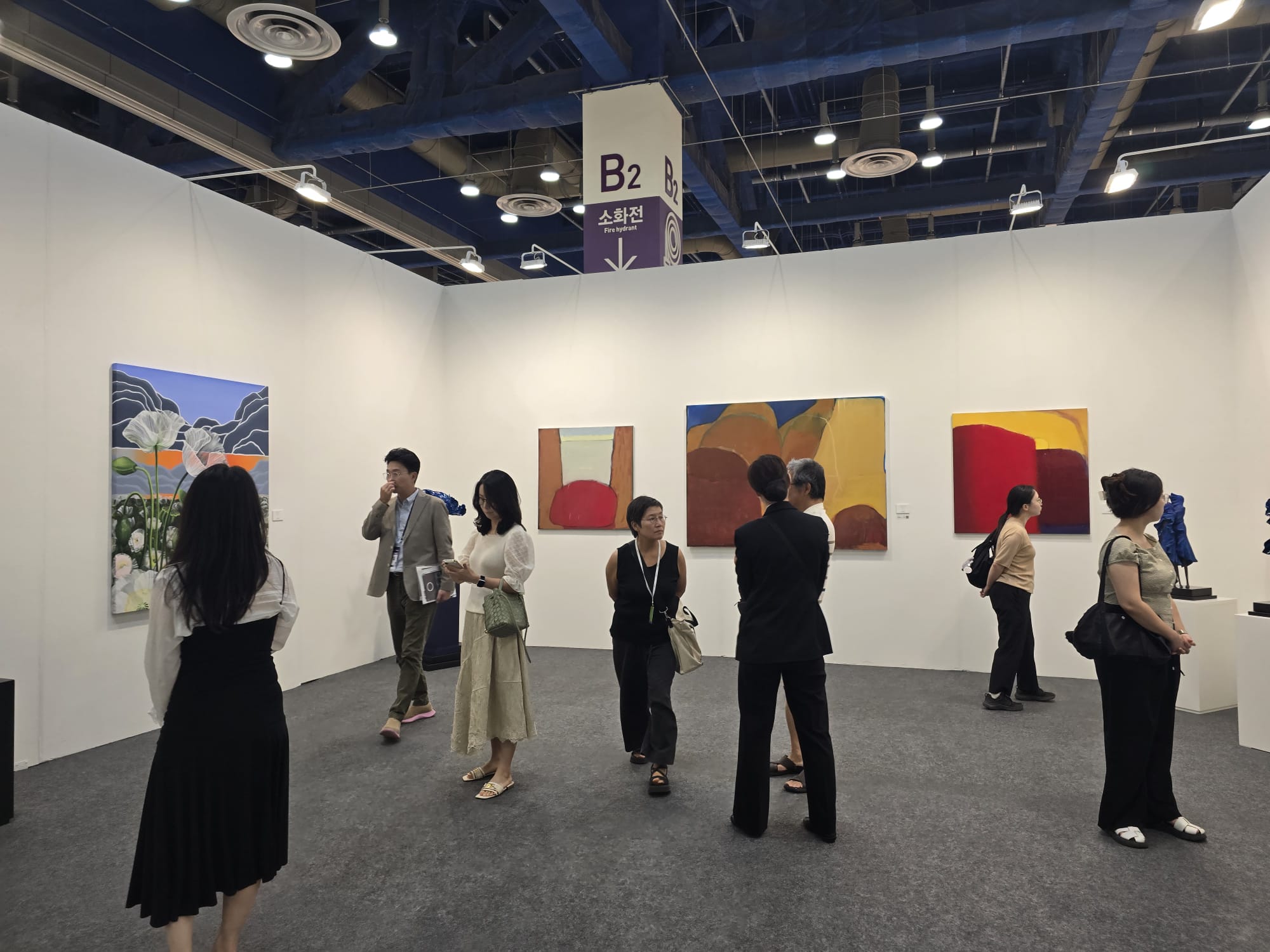
Artbooth Gallery display during Kiaf Seoul, 2026
The crowds came, Korean modern masters made headlines, and younger artists found buyers. What did Seoul Art Week actually tell us about the market?
For five days in September, Seoul became an art city on a grand scale. Kiaf Seoul and Frieze Seoul filled COEX with more than 300 galleries between them, while exhibitions and events drew visitors across the city. The fairs delivered major sales,but their most interesting story was the variety of works finding an audience.
Frieze Seoul welcomed more than 70,000 visitors, including representatives from 178 museums and institutions across 25 countries. Kiaf Frieze Seoul 2026 Market Settlement Report estimates Kiaf’s attendance at around 80,000. Those figures show the reach of the week, though visitors moving between the fairs should not be counted as 150,000 separate people.
A Korean master leads the sales
One of the week’s defining transactions was Kukje Gallery’s sale of a 1971 painting by Yoo Youngkuk for approximately USD 1.6 - 1.85 million. It was the highest reported sale by a Korean artist in Frieze Seoul’s five year history. Gallery Hyundai also reported sales of works by Kim Tschang-yeul, while international names including Adrian Ghenie and Antony Gormley attracted buyers.
These results show that collectors will still commit to exceptional works at substantial prices. They also reveal something distinctive about Seoul: Korean art is central to the fair’s international appeal. A collector arriving to see global galleries may leave having discovered an artist whose work is deeply connected to Korea’s own art history.
The energy extended well beyond headline sales
The market reports highlight brisk activity for emerging artists and works at more accessible prices, particularly at Kiaf. Frieze’s closing report offers a vivid example at the other end of the price range: more than 400 of 500 small paintings by the artistdpgp78, priced from $70, sold during the fair. Those purchases cannot be compared directly with a multimillion-dollar painting, but they demonstrate how many different ways people entered the market that week.
For galleries, this suggests an opportunity to build relationships across generations of collectors. Someone making a first purchase today may become a committed supporter of an artist over many years. The conversations around a work can matter as much as the speed of the sale.
Seoul’s museums helped give the week its depth
The fairs were only part of the experience. A Yoo Youngkuk retrospective at the Seoul Museum of Art and a major Do Ho Suh exhibition at MMCA Seoul gave visitors a chance to explore artists’ practices beyond the booths. Gallery events, late openings and exhibitions elsewhere in the city added to that sense of discovery.
This wider programme is one of Seoul’s strengths. Collectors can encounter an artist at a museum, see related work at a fair and continue the conversation at a gallery. It makes the city compelling to visit even for people who do not intend to buy immediately.
So, is the market recovering?
The global picture provides some encouragement. According to the Art Basel and UBS Global Art Market Report 2026, worldwide art sales rose 4% to an estimated$59.6 billion in 2025, while South Korea’s market grew 6%. Yet the same report describes uneven growth and rising operating costs for dealers. These are figures for2025, rather than a measurement of sales at Seoul’s September 2026 fairs.
That distinction matters. Reported transactions tell us which works found buyers, but neither fair’s announcements provide a complete picture of every sale. Strong attendance and notable deals are encouraging signs; they do not, on their own,establish how much the market grew during fair week.
Perhaps the clearest conclusion is that Seoul has a broad and engaged art audience.Buyers responded to Korean modern masters, international artists and emerging practices at very different price points. Museums brought further attention to the artists and ideas behind the market. The mood may have been more considered than exuberant, but that can create room for lasting connections.
Next year will offer another test. Frieze Seoul has announced a move to Dongdaemun Design Plaza in 2027 as COEX undergoes redevelopment, while Kiaf is expected to remain at COEX. The fairs’ shared location has made it easy for visitors to explore both; how audiences move between two venues will be worth watching.
For now, the message from Seoul Art Week 2026 is an inviting one, the city’s art market is larger than any single record sale. Its strength lies in the artists, galleries,museums and curious new collectors who keep the conversation going after the fair doors close.
-Hasintha Edirisinghe-
Follow Artbooth
Abu Dhabi: +971 52 338 4009
+971 2 442 0243
info@artboothgallery.com
Join Mailing List


